Blockchain technology has transformed the way the world thinks about digital transactions, financial infrastructure, and decentralized systems. Since the emergence of cryptocurrencies, proponents of blockchain have envisioned a future where global payments are faster, cheaper, and more accessible than anything offered by traditional banking networks. Yet despite remarkable technological progress, blockchain-based payment systems still struggle to match the speed and scalability of conventional financial infrastructure.
Modern payment giants process enormous volumes of transactions every second with minimal delays. Consumers have become accustomed to instant card payments, seamless mobile banking experiences, and highly reliable settlement systems. Blockchain networks, by comparison, continue to face technical and operational limitations that prevent them from fully competing with established payment rails on a global scale.
The challenge is not simply one of innovation versus tradition. Traditional payment systems have benefited from decades of optimization, regulatory development, and infrastructure investments. Blockchain, meanwhile, is attempting to solve a far more complex problem: enabling secure, decentralized, and transparent transactions without relying on centralized authorities.
Understanding the barriers to blockchain scalability is essential for evaluating its future role in global payments. While blockchain offers significant advantages in transparency and decentralization, overcoming its limitations remains one of the industry’s greatest technological challenges.
The Scale of Traditional Payment Networks
To appreciate blockchain’s scalability challenges, it is important to understand the capabilities of traditional payment infrastructure.
Modern payment networks are designed for:
- High transaction throughput.
- Near-instant authorization.
- Global availability.
- Operational reliability.
- Regulatory compliance.
- Fraud prevention.
- Seamless consumer experiences.
Centralized payment systems benefit from a relatively simple architecture. Transactions are processed by trusted entities operating highly optimized databases and data centers. Since these organizations control the entire network, they can prioritize efficiency and speed without requiring consensus among thousands of independent participants.
Traditional payment systems excel because they make deliberate trade-offs. They sacrifice decentralization in exchange for performance and control.
Blockchain networks, on the other hand, attempt to provide:
- Decentralization.
- Security.
- Transparency.
- Immutability.
- Permissionless participation.
Balancing these characteristics introduces significant technical complexity.
The Blockchain Scalability Problem
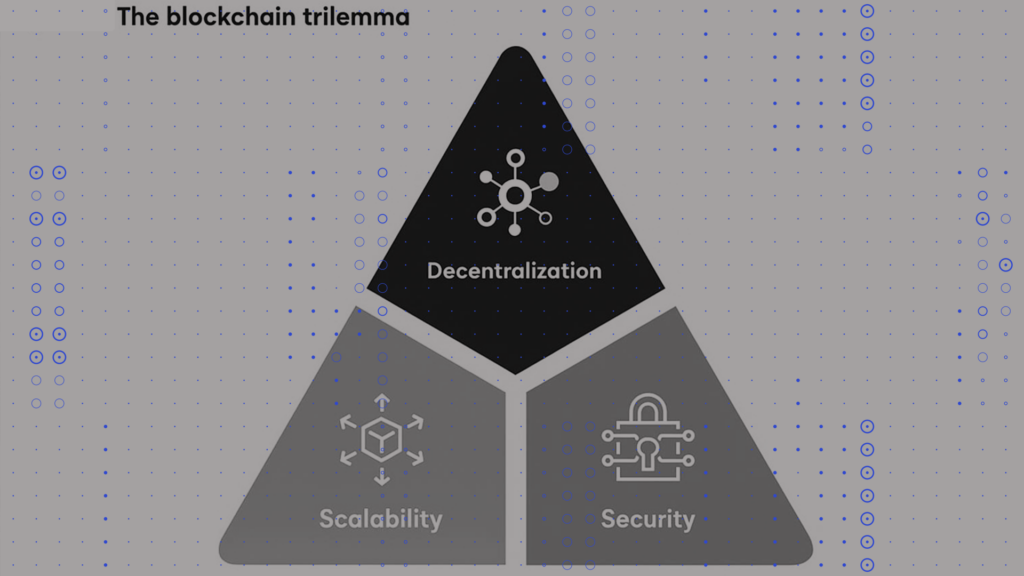
One of blockchain’s most fundamental challenges is often described as the “blockchain trilemma.”
This concept suggests that blockchain networks struggle to simultaneously maximize:
- Scalability.
- Security.
- Decentralization.
Improving one characteristic often affects the others.
For example:
- Increasing transaction throughput may reduce decentralization.
- Strengthening security mechanisms may decrease processing speed.
- Expanding network participation can increase computational requirements.
Developers continue to explore innovative approaches to address these trade-offs, but achieving an ideal balance remains difficult.
Transaction Processing Limitations
Traditional databases process transactions by updating records directly within centralized systems.
Blockchain networks operate differently.
Before a transaction is finalized, it must typically undergo several stages:
- Broadcast to network participants.
- Validation by nodes.
- Consensus agreement.
- Inclusion in a block.
- Confirmation by the network.
Each step introduces additional latency.
The result is that many blockchain networks process significantly fewer transactions per second than centralized alternatives.
Several factors contribute to these limitations:
Block Size Constraints
Blockchain transactions are grouped into blocks. The size of these blocks directly affects how many transactions can be processed simultaneously.
Larger blocks may improve throughput but can create problems such as:
- Increased storage requirements.
- Higher bandwidth demands.
- Reduced accessibility for smaller network participants.
- Greater centralization risks.
Designing optimal block parameters remains a complex engineering challenge.
Block Time Delays
Many blockchain networks intentionally introduce time intervals between block creation events.
Block times influence:
- Transaction speed.
- Security.
- Network synchronization.
- Consensus stability.
While shorter block times can improve user experience, they may also increase the likelihood of network inconsistencies and security vulnerabilities.
Consensus Mechanisms
Consensus mechanisms play a critical role in maintaining blockchain security.
Popular models include:
- Proof of Work.
- Proof of Stake.
- Delegated Proof of Stake.
- Various hybrid approaches.
Consensus systems are responsible for ensuring that all participants agree on the validity of transactions.
However, achieving distributed agreement inevitably introduces computational and communication overhead that centralized systems simply do not face.
Network Congestion and Transaction Costs
Blockchain networks frequently experience periods of congestion during times of increased demand.
High network utilization can lead to:
- Slower transaction confirmations.
- Increased fees.
- Reduced user satisfaction.
- Unpredictable processing times.
Traditional payment networks are also subject to capacity constraints, but their centralized architectures allow operators to scale infrastructure more directly.
Blockchain networks must preserve consensus and decentralization while expanding capacity—a significantly more difficult task.
Network congestion remains one of the largest obstacles preventing blockchain payments from achieving widespread mainstream adoption.
The User Experience Challenge
Consumers rarely care about the technical architecture behind payment systems. They prioritize:
- Speed.
- Simplicity.
- Reliability.
- Security.
- Low costs.
Traditional payment applications have spent decades refining the user experience.
Blockchain payments often introduce additional complexities such as:
- Wallet management.
- Private key storage.
- Transaction fees.
- Network selection.
- Confirmation delays.
- Compatibility issues.
Even if blockchain networks become technically faster, mainstream adoption will remain limited unless the user experience improves substantially.
Consumers expect payments to feel effortless. Blockchain infrastructure must become largely invisible if it hopes to compete with established financial services.
Infrastructure and Global Adoption
Global payment systems operate across:
- Financial institutions.
- Regulatory frameworks.
- Payment processors.
- Merchants.
- Mobile applications.
- Banking networks.
Blockchain infrastructure remains relatively young by comparison.
Several adoption challenges include:
Merchant Integration
Businesses require payment systems that are:
- Easy to implement.
- Cost-effective.
- Reliable.
- Regulatory compliant.
- Consumer-friendly.
Integrating blockchain payments often requires additional technical expertise and infrastructure investments.
Regulatory Fragmentation
Blockchain payments operate across international jurisdictions that maintain different regulations regarding:
- Digital assets.
- Financial reporting.
- Consumer protection.
- Taxation.
- Anti-money laundering requirements.
Regulatory uncertainty can significantly slow enterprise adoption.
Financial Infrastructure Compatibility
Blockchain-based payment solutions must coexist with existing financial systems.
Interoperability challenges remain significant when connecting:
- Banks.
- Payment gateways.
- Digital wallets.
- Traditional accounting systems.
- International settlement networks.
Building seamless bridges between legacy infrastructure and blockchain networks is an ongoing industry priority.
Layer-Two Scaling Solutions
One of the most promising approaches to blockchain scalability involves layer-two technologies.
Layer-two solutions operate on top of existing blockchain networks and aim to improve:
- Transaction throughput.
- Cost efficiency.
- User experience.
- Scalability.
These systems process large volumes of transactions separately before periodically settling information on the underlying blockchain.
Advantages include:
- Faster transaction speeds.
- Reduced fees.
- Improved scalability.
- Enhanced network efficiency.
Layer-two technologies are increasingly viewed as essential components of blockchain’s long-term growth strategy.
Rather than replacing existing blockchains, they complement them by addressing performance limitations while preserving security guarantees.
Alternative Blockchain Architectures
Developers are actively experimenting with new blockchain designs that improve scalability.
Emerging approaches include:
Modular Blockchain Systems
Modular architectures separate core blockchain functions such as:
- Execution.
- Data availability.
- Consensus.
- Settlement.
This specialization enables greater flexibility and improved performance.
Sharding
Sharding divides blockchain networks into smaller segments that process transactions simultaneously.
Potential benefits include:
- Increased throughput.
- Improved scalability.
- Reduced congestion.
However, implementing sharding securely presents significant technical challenges.
Permissioned Networks
Certain enterprise applications prioritize performance over full decentralization.
Permissioned blockchain systems allow organizations to:
- Restrict network participation.
- Increase transaction capacity.
- Improve operational efficiency.
- Simplify governance models.
These networks are particularly attractive for business and institutional use cases.
Can Blockchain Ever Match Traditional Payments?
The question is not whether blockchain can become faster. Technological progress continues to improve transaction speeds across numerous blockchain ecosystems.
The more important question may be whether blockchain should attempt to replicate traditional payment systems at all.
Blockchain offers advantages that conventional infrastructure cannot easily provide:
- Decentralization.
- Programmability.
- Transparency.
- Global accessibility.
- Tokenized asset support.
- Smart contract integration.
Rather than competing solely on transaction speed, blockchain may ultimately succeed by enabling entirely new forms of financial infrastructure.
Future payment systems are likely to combine:
- Traditional banking services.
- Stablecoin settlements.
- Layer-two scaling technologies.
- Tokenized financial assets.
- Smart contract automation.
- Cross-border interoperability.
Hybrid financial ecosystems may offer the best of both worlds.
The Future of Blockchain Payments
Several developments are expected to shape the future of blockchain scalability:
- More sophisticated layer-two solutions.
- Improved consensus mechanisms.
- Greater interoperability between networks.
- Enhanced regulatory clarity.
- Institutional infrastructure investments.
- Simplified consumer interfaces.
- Expanded enterprise adoption.
As these innovations mature, blockchain payments will become increasingly practical for both businesses and consumers.
The industry’s greatest strength lies not in replacing traditional systems overnight but in gradually improving and complementing existing financial infrastructure.
Blockchain’s evolution should be viewed as a long-term technological transition rather than a short-term competition with legacy payment networks.
Conclusion
Blockchain technology has made significant progress over the past decade, but scalability remains one of its most important challenges. Transaction throughput limitations, network congestion, consensus requirements, regulatory complexity, and user experience issues continue to prevent blockchain from outperforming traditional payment systems in speed.
Traditional financial infrastructure benefits from centralized control and decades of optimization, while blockchain must balance scalability with security and decentralization. This fundamental difference explains why matching conventional payment performance is far more difficult than it initially appears.
Nevertheless, blockchain’s future should not be measured solely by transaction speed. Its true value lies in creating programmable, transparent, and globally accessible financial systems that extend far beyond simple payments.
As scaling technologies continue to mature, blockchain may not replace traditional payment networks entirely. Instead, it is increasingly likely to become a foundational layer of the next generation of global financial infrastructure—one that combines innovation with the reliability consumers and businesses already expect.