The digital transformation of modern business is no longer limited to cloud computing, artificial intelligence, or automation software. One of the most significant technological developments reshaping corporate operations today is the rise of smart contracts. Built on blockchain technology, smart contracts are changing how organizations execute agreements, manage workflows, and reduce administrative complexity.
While blockchain is often associated with cryptocurrencies and digital assets, smart contracts represent one of its most practical and transformative applications. These self-executing programs automatically enforce predefined conditions and perform actions when specific requirements are met. Their ability to eliminate manual intervention, reduce operational costs, and increase transparency has made them increasingly attractive across industries.
Businesses worldwide are beginning to understand that smart contracts are not merely experimental tools for decentralized finance. They are becoming an essential component of modern enterprise infrastructure, capable of automating legal, financial, and operational processes at a scale that traditional systems struggle to achieve.
The future of business agreements may not involve stacks of paperwork, lengthy approval chains, or intermediaries overseeing every transaction. Instead, it may rely on programmable contracts that execute themselves with precision, speed, and transparency.
Understanding Smart Contracts
A smart contract is a computer program deployed on a blockchain that automatically performs actions when predetermined conditions are satisfied. Unlike traditional contracts, which require human oversight and legal enforcement mechanisms, smart contracts operate according to code.
Their fundamental characteristics include:
- Automation of business processes.
- Transparency of execution.
- Immutable transaction records.
- Reduced reliance on intermediaries.
- Enhanced security through cryptographic mechanisms.
- Greater operational efficiency.
Once deployed, smart contracts cannot be arbitrarily modified without following predefined governance procedures. This creates a predictable environment in which all parties understand how agreements will be executed.
For businesses, smart contracts offer a new approach to trust. Instead of relying entirely on third parties to enforce agreements, organizations can rely on transparent and verifiable code.
Why Businesses Are Paying Attention
Modern enterprises face numerous operational challenges that involve repetitive and resource-intensive processes.
Common issues include:
- Manual contract administration.
- Payment delays.
- Compliance complexities.
- High transaction costs.
- Human error in operational procedures.
- Lengthy approval workflows.
- Inefficient document management.
Smart contracts address these problems by introducing programmable automation into business operations.
The potential benefits are substantial:
Cost Reduction
Organizations spend significant resources managing contracts, processing payments, and maintaining compliance frameworks. By automating routine operations, smart contracts can dramatically reduce administrative expenses.
Automation minimizes the need for:
- Manual verification.
- Third-party intermediaries.
- Paper-based documentation.
- Reconciliation procedures.
- Contract management overhead.
Increased Efficiency
Traditional business agreements often require multiple stakeholders to review and approve transactions.
Smart contracts execute predefined instructions automatically, enabling:
- Faster transaction settlement.
- Real-time process execution.
- Reduced operational bottlenecks.
- Improved coordination among participants.
Tasks that previously required days or weeks can potentially be completed within minutes.
Greater Transparency
Every action performed by a smart contract is recorded on the blockchain.
Participants can verify:
- Execution conditions.
- Transaction history.
- Payment records.
- Compliance procedures.
- Contractual obligations.
Transparency reduces disputes and strengthens confidence among business partners.
Smart Contracts in Legal Processes
Legal departments are increasingly exploring how programmable agreements can improve efficiency while maintaining regulatory compliance.
Although smart contracts are not intended to replace traditional legal systems entirely, they are highly effective when applied to clearly defined operational obligations.
Contract Execution
Many commercial agreements involve straightforward conditional logic.
Examples include:
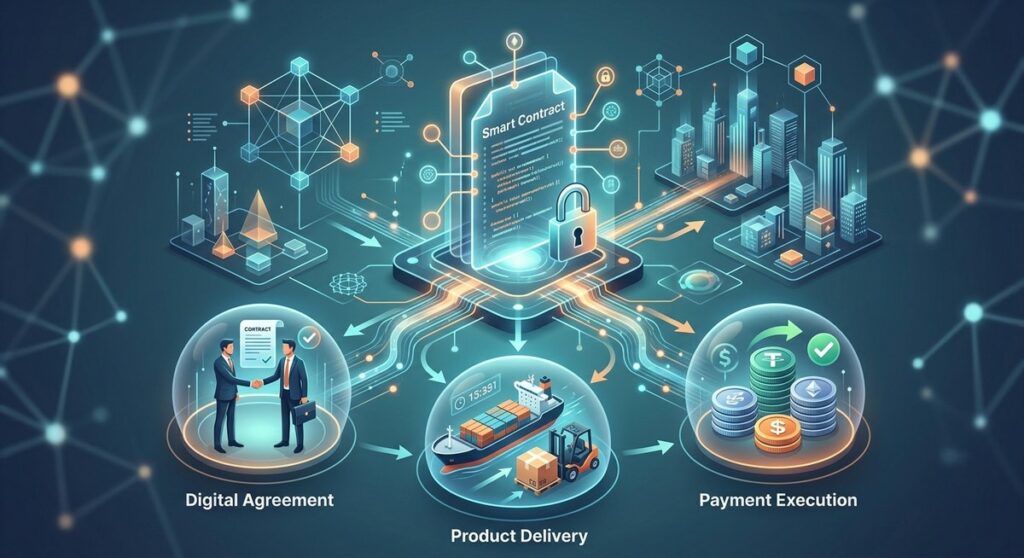
- Release payments upon delivery confirmation.
- Transfer ownership after successful verification.
- Grant access rights after approval.
- Trigger refunds when contractual requirements are not met.
Smart contracts can automate these obligations without requiring continuous human intervention.
This automation significantly reduces:
- Administrative delays.
- Human error.
- Contractual disputes.
- Processing costs.
Intellectual Property Management
Businesses managing intellectual property rights can use smart contracts to automate:
- Licensing agreements.
- Royalty distributions.
- Usage tracking.
- Revenue sharing.
Whenever licensed content is used or purchased, payments can be distributed automatically according to predetermined contractual rules.
This approach provides creators and organizations with greater transparency and faster compensation mechanisms.
Legal Compliance Automation
Regulatory compliance continues to grow more complex across industries.
Smart contracts can assist businesses by automating:
- Reporting requirements.
- Documentation procedures.
- Regulatory checks.
- Audit trails.
- Compliance notifications.
While legal professionals remain essential for interpreting regulations, automation significantly improves operational efficiency.
Operational Applications Across Industries
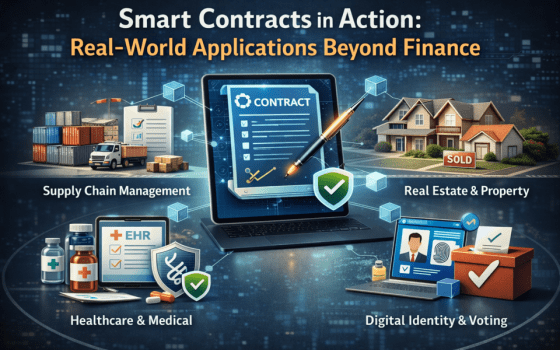
Smart contracts have expanded far beyond financial applications. Businesses are discovering valuable use cases across multiple sectors.
Supply Chain Management
Supply chains involve numerous participants operating across different jurisdictions.
Smart contracts can automate:
- Shipment verification.
- Inventory updates.
- Supplier payments.
- Customs documentation.
- Insurance claims.
- Delivery confirmations.
For example, payment to suppliers can be released automatically once shipment tracking systems confirm successful delivery.
This reduces disputes while improving cash flow management for both buyers and suppliers.
Human Resources
Human resource departments manage a variety of administrative responsibilities that can benefit from automation.
Potential applications include:
- Employment agreements.
- Payroll processing.
- Performance-based compensation.
- Benefits administration.
- Contractor payments.
- Employee credential verification.
Smart contracts can ensure that compensation is distributed according to transparent and predefined performance metrics or contractual obligations.
Financial Operations
Financial departments are among the earliest adopters of smart contract technology.
Applications include:
- Automated invoicing.
- Expense reimbursements.
- Treasury management.
- Revenue distribution.
- Loan agreements.
- Subscription payments.
Businesses can significantly reduce settlement times while improving financial transparency.
Cross-border payments are particularly attractive candidates for smart contract implementation, as traditional international transfers often involve multiple intermediaries and lengthy processing periods.
Smart Contracts and Corporate Governance
Corporate governance processes frequently involve complex approval mechanisms.
Organizations can automate governance activities such as:
- Shareholder voting.
- Board approvals.
- Budget allocation.
- Investment authorizations.
- Compliance reporting.
Blockchain-based governance systems offer several advantages:
- Transparent decision-making.
- Immutable voting records.
- Automated execution of approved proposals.
- Improved accountability.
- Reduced administrative overhead.
Decentralized governance mechanisms are increasingly being explored not only by blockchain-native organizations but also by traditional enterprises seeking greater operational transparency.
Smart Contracts in Insurance
The insurance industry represents one of the most promising applications for smart contract automation.
Traditional insurance claims often involve:
- Manual documentation.
- Lengthy investigations.
- Multiple approval stages.
- Administrative costs.
- Payment delays.
Smart contracts can streamline these processes considerably.
Examples include:
Travel Insurance
If flight information confirms a delay exceeding predefined conditions, compensation can be issued automatically without requiring customers to submit claims.
Supply Chain Insurance
If sensors detect that transported goods were exposed to unacceptable environmental conditions, insurance payouts may be triggered automatically.
Parametric Insurance
Certain insurance products rely on objective external data such as:
- Weather conditions.
- Natural disaster metrics.
- Transportation records.
- Market indicators.
Smart contracts can execute claims immediately once verified data satisfies contractual requirements.
This significantly improves customer experience while reducing operational costs.
Integrating Smart Contracts with Emerging Technologies
The full potential of smart contracts becomes apparent when they are integrated with complementary technologies.
Artificial Intelligence
Artificial intelligence can enhance smart contracts through:
- Predictive analytics.
- Risk assessment.
- Fraud detection.
- Intelligent process optimization.
AI systems can provide insights that influence how smart contracts execute predefined business logic.
Internet of Things (IoT)
IoT devices continuously generate valuable operational data.
Examples include:
- GPS tracking.
- Temperature monitoring.
- Inventory management.
- Equipment diagnostics.
- Energy consumption metrics.
Smart contracts can automatically respond to IoT-generated events, enabling real-time business process automation.
Digital Identity Solutions
Reliable digital identity systems are essential for enterprise adoption.
Smart contracts become significantly more powerful when integrated with:
- Identity verification mechanisms.
- Digital signatures.
- Authentication systems.
- Access control frameworks.
This combination improves both security and regulatory compliance.
Challenges Facing Smart Contract Adoption
Despite their enormous potential, smart contracts face several important challenges.
Legal Recognition
Jurisdictions differ considerably in their treatment of blockchain-based agreements.
Key legal questions include:
- Are smart contracts legally enforceable?
- How should disputes be resolved?
- Which jurisdictions govern international agreements?
- How should contractual errors be addressed?
Governments and regulatory bodies continue to develop frameworks that clarify the legal status of programmable agreements.
Coding Risks
Smart contracts are only as reliable as the code they contain.
Programming errors may result in:
- Financial losses.
- Operational failures.
- Security vulnerabilities.
- Unexpected contract behavior.
Businesses must prioritize:
- Independent code audits.
- Security testing.
- Formal verification procedures.
- Ongoing monitoring.
The immutability of blockchain systems makes preventative security measures particularly important.
Scalability Issues
Public blockchain networks may experience limitations related to:
- Transaction throughput.
- Network congestion.
- Processing costs.
- Latency.
Enterprises are increasingly exploring alternative solutions such as:
- Permissioned blockchains.
- Layer-two scaling technologies.
- Hybrid infrastructure models.
Selecting the appropriate architecture remains critical for successful implementation.
Regulatory Compliance
Businesses must ensure that smart contracts comply with existing regulations concerning:
- Data privacy.
- Consumer protection.
- Financial reporting.
- Tax obligations.
- Industry-specific requirements.
Automation should complement regulatory compliance rather than attempt to bypass it.

The Future of Smart Contracts
The next decade is likely to witness substantial growth in enterprise smart contract adoption.
Several trends are emerging:
- Greater legal recognition of blockchain agreements.
- Improved interoperability between blockchain networks.
- Enhanced security standards.
- Wider integration with enterprise software.
- Expansion of tokenized business assets.
- Increased automation across industries.
Rather than replacing traditional contracts entirely, smart contracts will likely coexist alongside conventional legal frameworks.
Businesses are expected to adopt hybrid models where legal agreements establish broad obligations while smart contracts automate operational execution.
This combination offers the advantages of both legal flexibility and technological efficiency.
Conclusion
Smart contracts are transforming the way businesses manage agreements, automate processes, and establish trust between participants. Their ability to execute predefined actions transparently and securely positions them as one of blockchain technology’s most valuable enterprise applications.
From supply chain management and financial operations to legal compliance and insurance, programmable contracts are helping organizations reduce costs, improve efficiency, and eliminate unnecessary intermediaries.
Although challenges surrounding regulation, scalability, and security remain, the momentum behind enterprise adoption continues to grow. Smart contracts are evolving from experimental blockchain applications into foundational tools for modern business automation.
The companies that successfully integrate smart contracts into their operations will not simply gain technological advantages—they will redefine how business agreements are created, executed, and enforced in an increasingly digital economy.